Helmholtz Institute IEK-12Münster, Germany
Battery Research on the Münster Campus
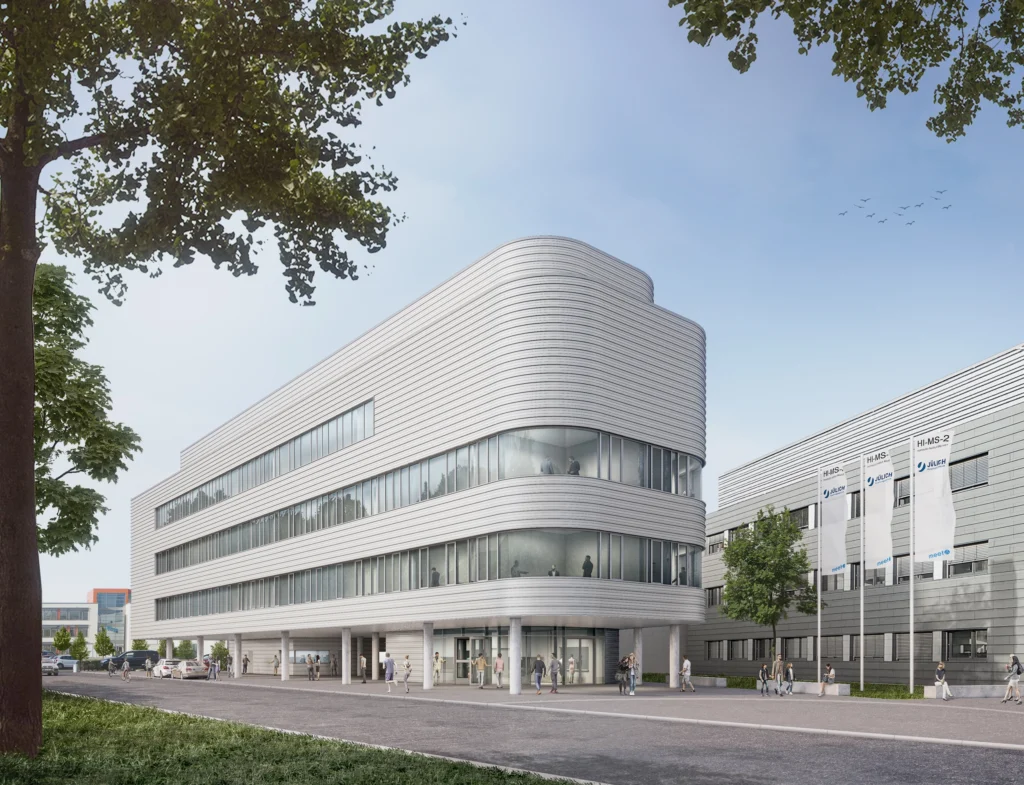
The extension of the Helmholtz Institute Münster consolidates laboratories, offices, and spaces for scientific exchange in a compact building for around 110 employees. Here, an international, interdisciplinary team researches new battery technologies based on electrolytes. The design continues the spatial proximity to the neighboring MEET battery research center in the outdoor space as well: both entrances are oriented toward a shared forecourt.
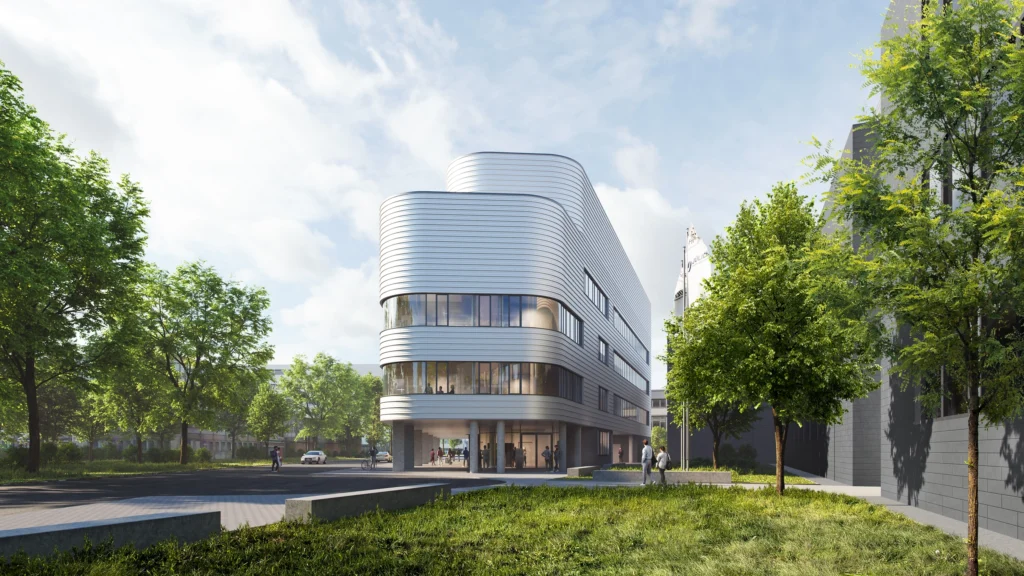
The main entrance of the new institute building is located on the rounded front side. Its orientation toward the MEET entrance defines the square as a shared arrival area. The elevated ground floor zone opens the building structure to the University of Münster campus. A level, barrier-free connection remains between the two plinth elements. In this way, the space under the building becomes part of the pathways on the research site.
Project Overview
Location
Münster, Germany
VgV with Design
Feasibility study
Construction Period
2022 – 2026
Area (GFA)
5,257 m²
Size (GV)
22,947 m³
A shared forecourt for two research buildings
The two base elements house specialised laboratory facilities, including microscopy, as well as the technical services. Above these are the laboratory and office spaces, along with the lecture theatre and seminar areas. The structure, comprising three full storeys, is complemented by a staggered storey housing the technical control centre.
The concentration of specialised functions and technical infrastructure within the plinth elements also shapes the building’s external form: the compact structure stands out as a cohesive volume in contrast to the open ground floor.
A metal band façade wraps around the building. Bands of windows, some of which continue round the curved front, open up the research and work spaces to the surroundings and emphasise the horizontal lines of the envelope. Its materiality and block-like form with rounded contours evoke the image of a battery. The building’s scientific purpose is thus reflected in its architectural expression.