King Salman Park
The Green Heart of Riyadh
King Salman Park, currently under construction in the heart of Saudi Arabia’s capital, will be the world’s largest inner-city park open to the public. Covering an area of 16.7 km², it is five times larger than New York’s Central Park. The site is the former Riyadh Airport, which is being transformed into an eco-transformative urban renewal project. The park area is accessed via the circular Innovation Loop. Inside this ring lies Central Park, featuring wooded areas, deep wadis, and diverse garden and climate zones. The so-called “green fingers” form a seamless transition to the surrounding city. The organically shaped transition between landscape and urban space highlights the unique character of the public park, which will be accessible around the clock to residents, tourists, and those interested in nature, culture, and sports, offering a novel nature experience in the heart of the urban environment. Interdisciplinary research has made it possible to make the desert soil fertile, ensure a sustainable water supply, and carefully select and plant climate-resilient plants and trees. As a result, King Salman Park will contribute to climate improvement, species diversity, and biodiversity in Riyadh as a sustainable greening project. The park will not only be home to a total of 30 million plants across 800 varieties and 1.1 million trees, but will also offer visitors an ecologically valuable natural and recreational space. Cultural and recreational facilities, such as the Museum of the Earth, the open-air cinema, and the amphitheater, are currently under construction. King Salman Park is a joint venture project with Happold and Setec as planning partners for the overall design, led by Gerber Architekten.
| Location | Riyadh, Saudi Arabia |
| Client | King Salman Park Foundation |
| Area | 16,6 km² |
| Plant diversity | 200 existing species + 600 new plant species |
| Climate-Adapted Urban Forest | consist of 1.1 million trees |
| Regenerative soils | 18.4 million cubic meters |
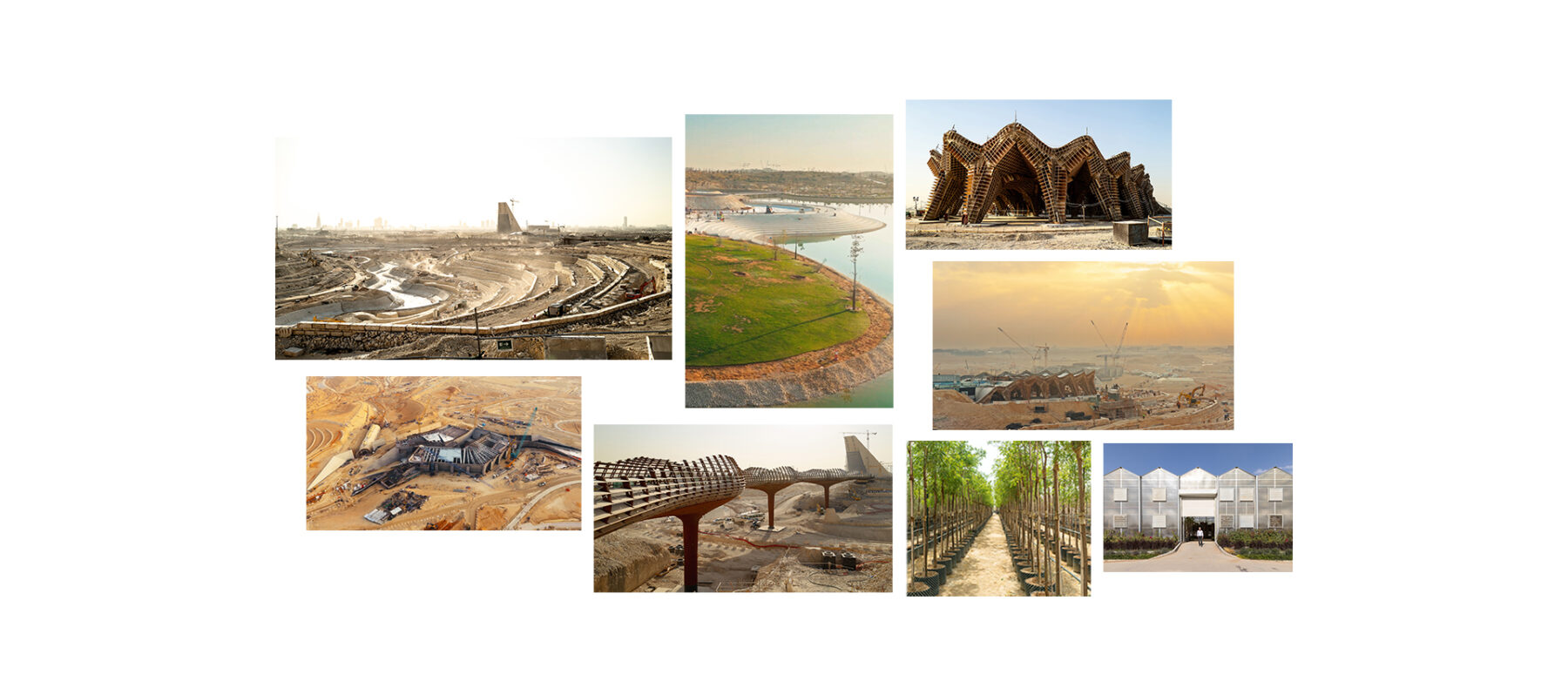
Transformation of Urban Spaces
The Development of Ecological Infrastructure
King Salman Park is a key component in increasing the proportion of green space in the Saudi capital and will contribute to sustainable climate improvement. To this end, a system has been developed that enables Riyadh’s desalinated wastewater to be used for water supply. The foundation for the vegetation consists of 18.4 million cubic meters of fertile soil mix, which also functions as a sponge-like substrate. The vegetation, specially suited for these high temperatures, comprises 50 percent native plants and 50 percent climate-resilient plants from other parts of the world. To create a climatically pleasant environment for people and vegetation, sophisticated terrain modulation was also implemented, and a system of water features and watercourses was integrated into the park area, creating natural evaporative cooling and diverse microclimates. Shade-providing elements such as rest arcades and colonnades are also arranged at regular intervals throughout the park. These mitigate direct sunlight and create pleasantly shaded paths and gathering areas. The lush and diverse natural environment plays a decisive role. Tree coverage is 65%, and ground coverage is 95%.

Landscape and Architecture
A key feature of King Salman Park is the symbiotic relationship between architecture and landscape. It is based on the Salmani design philosophy and rooted in centuries-old local building traditions. Characteristic features include climate-adapted building structures that are closely integrated into the landscape, the use of cooling building materials, the utilization of natural air circulation, and the strategic implementation of shading concepts through vegetation and shading elements.
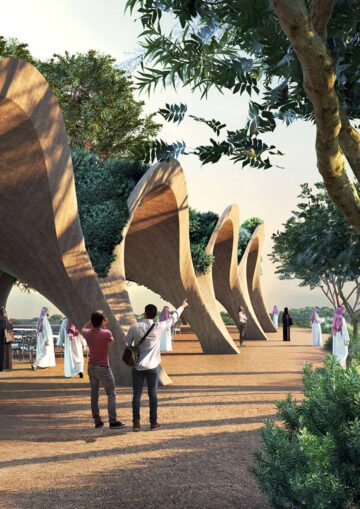
Park Overlook
The Park Overlook is situated at the highest point in the park, offering a panoramic view of Central Park’s terraced landscape, which slopes downward toward the center. As the highest point topographically, the Park Overlook serves as a landmark visible from afar within the park grounds. It opens up to the surroundings with large arches and houses a shaded lounge area with water features inside the radially arranged cross vault, inviting visitors to linger. The exposed location offers a panoramic view of the park landscape, which surrounds the viewer on all sides and immerses them in the natural experience.
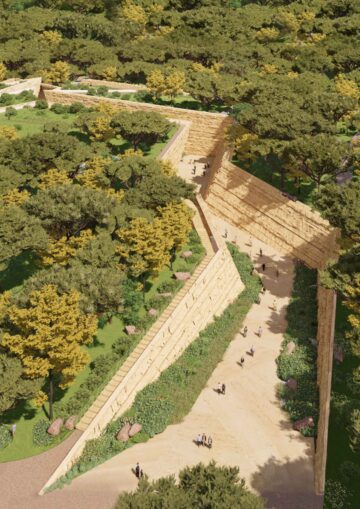
Museum of the Earth
The Museum of the Earth was designed in response to the topography. It extends like a canyon into the deep layers of the earth, using natural light to create an immersive yet climatically comfortable spatial experience. Like a narrow wadi, it lies within the earth, illuminated through cracks, cavities, and fissures. Its sloping walls evoke associations with the idea of rock strata and the layers of time they contain.
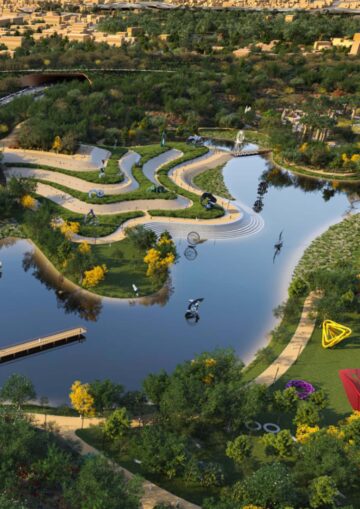
Art Park
Located outside Central Park, Art Park is designed as a public art park. It offers numerous opportunities to display sculptures and works of art outdoors, and its pathways and landscaping have been designed accordingly. A circular path winds around Art Park Lake, from which visitors can view the exhibits in the park and on the water. The interplay of art and architecture is also evident in the use of open spaces as exhibition areas and in the selection of low-growing vegetation. The shade-providing canopies are inspired by the protective crowns of trees.